Multilingual Booking Support: Are You Ready?
You don’t need to run a tourist hotspot to feel this: your booking journey has to work for a mix of guests.
Locals, expats, travellers, business diners, and last-minute walk-ups who find you on Maps and book on the spot.
If your reservation flow only speaks one language, you’re asking guests to “figure it out”. That’s where misunderstandings creep in and no-shows follow.
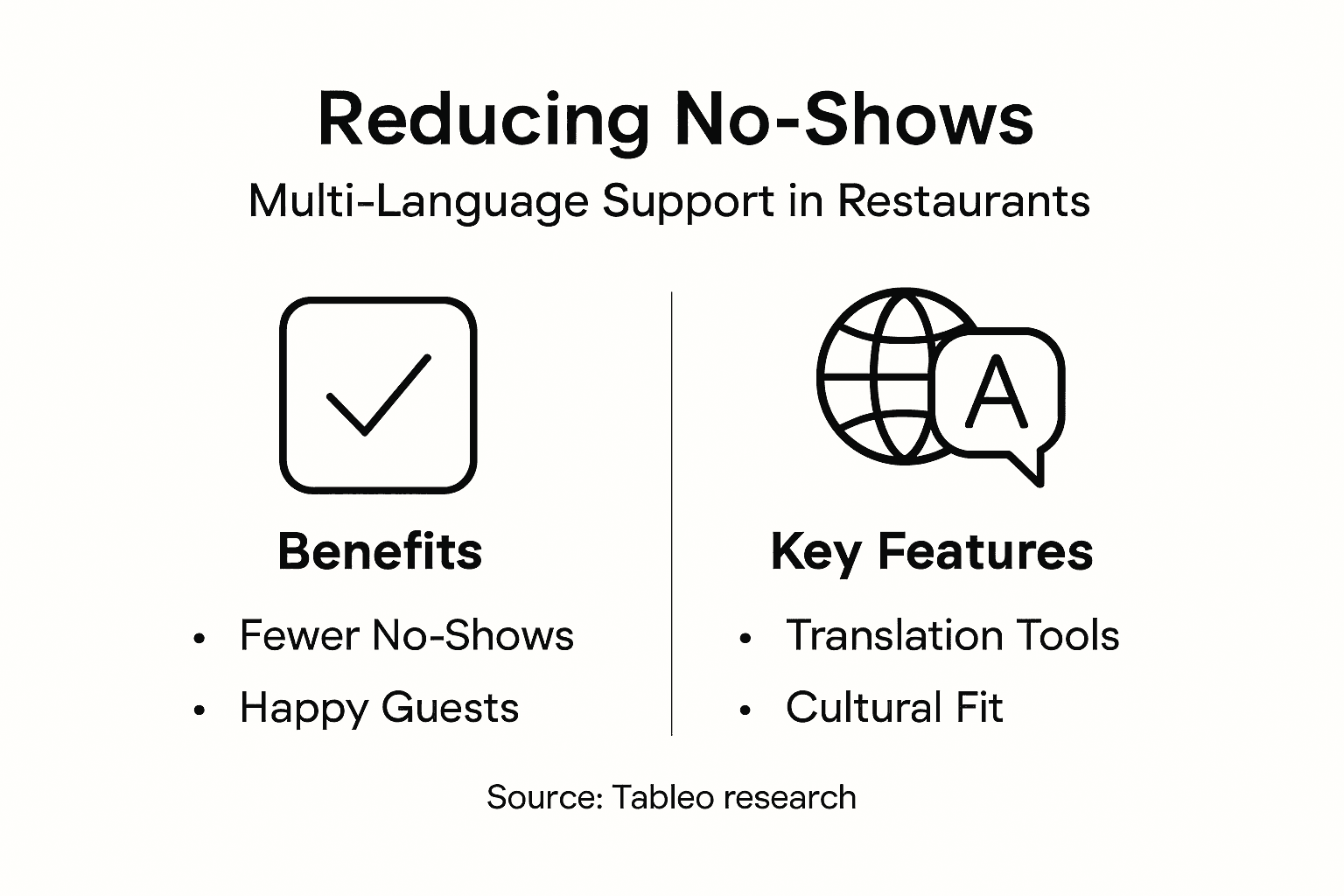
Multi-language booking support helps you keep the reservation process clear, familiar, and low-friction for more guests. And when guests feel confident they booked correctly, they’re far more likely to show up, message you if plans change, or cancel properly instead of disappearing.
Table of Contents
What multi-language booking support actually means
Multi-language booking support is exactly what it sounds like, but done properly it’s more than swapping words from one language to another.
It’s a full booking journey that works naturally for the guest, from the booking widget to the confirmation message to the reminder that hits their phone.
Think about the moments where guests get nervous: choosing the right time, understanding your seating rules, spotting whether kids are allowed at a certain hour, knowing how to amend a booking, or figuring out whether a deposit is required. If any of that is unclear, you’ll get more mistakes, more back-and-forth, and more “we didn’t understand” no-shows.
In practice, multi-language booking support usually means your system detects (or lets the guest choose) their language and then keeps the important bits consistent across the whole journey. That includes the booking form, the confirmation, the reminder, and the message they use if they need to change or cancel.
And yes, it directly supports better restaurant online booking performance because fewer guests drop out halfway through the form when they’re unsure what they’re agreeing to.
Here’s the simple operator’s view: if the guest can book in the language they’re most comfortable in, you get cleaner reservations, fewer misunderstandings, and fewer empty tables you can’t sell twice.
Pro tip. Test each language with native speakers (or at least bilingual staff) using real scenarios: “I want to book for 6 at 19:30, add an allergy note, then change to 20:00.” If they hesitate, your guests will too.
To make the impact more concrete, here’s what you typically improve when language is handled well:
| Impact area | What improves for guests | What it means for you |
|---|---|---|
| Customer inclusivity | More people feel welcome to book | Broader reach without extra marketing spend |
| Booking accuracy | Fewer mistakes in time, party size, and notes | Less chaos on the diary and fewer “wrong booking” no-shows |
| Trust building | Guests understand what happens next | More follow-through, better cancellation behaviour |
| Professional image | Everything feels organised and intentional | Stronger reputation, better reviews, more repeats |
The must-have features to get right
A solid multi-language setup has to cover the essentials that actually affect bookings. Not the “nice-to-haves” that look good in a feature list, but the things that stop guests from making a mistake or bailing out.
If you’re reviewing a platform (or auditing your current one), these are the features that matter most day-to-day:
- Language selection that’s obvious: auto-detection is helpful, but guests should always be able to switch languages easily.
- Local date and time formats: don’t make a guest guess whether 03/04 means March or April.
- Translated confirmations and reminders: the booking form can be perfect, but if the confirmation comes in another language, confusion returns.
- Clear rules where it counts: deposits, cancellation windows, seating duration, and any “we can’t guarantee” notes must read cleanly.
- Character support: names, notes, and allergens should accept the scripts guests actually type in.
One extra layer that’s worth thinking about is what happens behind the scenes. If you’re using a system for restaurant reservation management, you want language preferences to flow into your guest notes and messaging, so your team isn’t starting from scratch every time.

Pro tip. Don’t translate everything first. Translate what affects attendance first: confirmations, reminders, changes/cancellations, deposits, and any “important notes” that protect your service flow.
Why language clarity cuts no-shows
No-shows aren’t always rude, a lot of them are preventable operational problems: the guest didn’t fully understand the details, didn’t realise they had to confirm, didn’t know how to cancel, or booked multiple places “just in case” and only kept one.
Multi-language support reduces those problems because it removes uncertainty at the exact points where guests decide whether they’re committed. When the message feels familiar and easy to act on, people follow through. And when it’s confusing, they procrastinate until it’s too late to cancel.
In practical restaurant terms, language clarity helps you in three ways:
- Fewer accidental no-shows: guests don’t misread the time, date, or booking conditions.
- More proactive cancellations: guests understand the cancellation process and actually use it.
- Less staff time spent translating: your team isn’t stuck writing ad-hoc messages or playing phone tag.
If no-shows are a recurring headache for you, it’s worth pairing language support with a proper strategy to reduce no-shows (clear policies, smart reminders, and consistent follow-ups), so you’re not relying on a single fix.
Pro tip. Track no-show rate by language preference. You’ll spot where confusion is happening and what needs rewriting.
Where translations go wrong in real life
This is the part most venues only learn after the complaints start: bad translations don’t just look messy, they change meaning. And a small meaning change in a booking journey can create big service problems.
The common traps usually look like this:
1) Literal translations of hospitality language.
“We hold the table for 15 minutes” sounds straightforward in English, but in another language it may read as “we keep it for 15 minutes no matter what,” which sets expectations you won’t meet on a busy Saturday.
2) Deposit and cancellation wording that feels aggressive.
Some languages need more context to keep the tone polite. If your message feels like a threat, guests may book elsewhere, or worse, book and then ghost you.
3) Date and time formatting confusion.
Even a perfect translation won’t help if your format doesn’t match local conventions. This is one of the fastest ways to create “we thought it was tomorrow” scenarios.
4) Menu and allergen terminology mistakes.
Guests use booking notes for serious dietary info. If you translate that badly, you create risk, not just annoyance.
5) Right-to-left languages and layout issues.
If you support Arabic or Hebrew, the interface has to respect directionality, spacing, and labels. Otherwise it becomes unreadable, even if the words are technically correct.
The fix isn’t “never use automated translation.” The fix is treating translation as an operational system: write clean source text, keep sentences short, avoid slang, and review the messages guests actually receive. Then keep iterating.
Cost and compliance: what to plan for
Multi-language support isn’t free, but it’s usually cheaper than the hidden cost of missed covers, staff time spent fixing misunderstandings, and the reputational damage of guests feeling unwelcome or confused.
The real costs tend to fall into a few buckets: translation quality (professional vs automated), setup time, message templates, ongoing updates when you change policies, and staff training so your team knows what the guest sees in each language.
There’s also a compliance angle worth taking seriously. Even if you’re not a public-sector business, accessibility and clarity standards are moving in one direction: toward experiences that are usable and understandable for everyone. Treat your booking flow as your digital front door and you’ll avoid avoidable friction and disputes.
Pro tip. Keep your booking messages “policy-proof.” When you update deposits, cancellation terms, or seating times, update all languages at the same time. Mixed versions are a fast way to create arguments at the host stand.
Bringing it all together without making it complicated
You don’t need to support 20 languages to see results. Start with the languages your guests actually use, then make the booking journey consistent from start to finish. When the guest understands the booking, they’re more likely to respect it. Simple as that.
If you’re tightening up operations, multi-language support works best when it’s part of a wider reservation setup: clean diary rules, clear confirmations, and reminders that don’t sound robotic. That’s where a reliable restaurant reservation system earns its keep, because you can manage the guest experience without adding admin work to your day.
Frequently Asked Questions
How does multi-language booking support reduce no-shows?
It removes the “I wasn’t sure” moments. When confirmations, reminders, and cancellation steps are in the guest’s preferred language (and the date/time format makes sense to them), you get fewer accidental misses and more proper cancellations.
Which parts of the booking journey should be translated first?
Start with anything that affects attendance: the booking form labels, confirmation messages, reminder messages, cancellation/modification steps, and deposit or cancellation policy wording.
Is automatic browser language detection enough?
It’s a good helper, but it shouldn’t be your only option. Guests should always be able to switch languages manually, and your system should remember their choice so they don’t have to fight the interface every visit.
What’s the biggest translation mistake restaurants make?
Translating literally without checking meaning and tone. In hospitality, small wording shifts can change expectations around table holding time, deposits, and cancellation rules, which is exactly where disputes and no-shows come from.